
Imagine walking into your favorite coffee shop one morning and discovering that the front door has been moved.
Not locked. Not closed for renovations. Just moved somewhere nobody can find it.
The coffee is still excellent. The staff is still friendly. Everything inside works perfectly. But customers who used to walk through the door every day are suddenly wandering around the block, wondering where the place went.
That’s a surprisingly accurate picture of what can happen to an online business when a platform changes its rules.
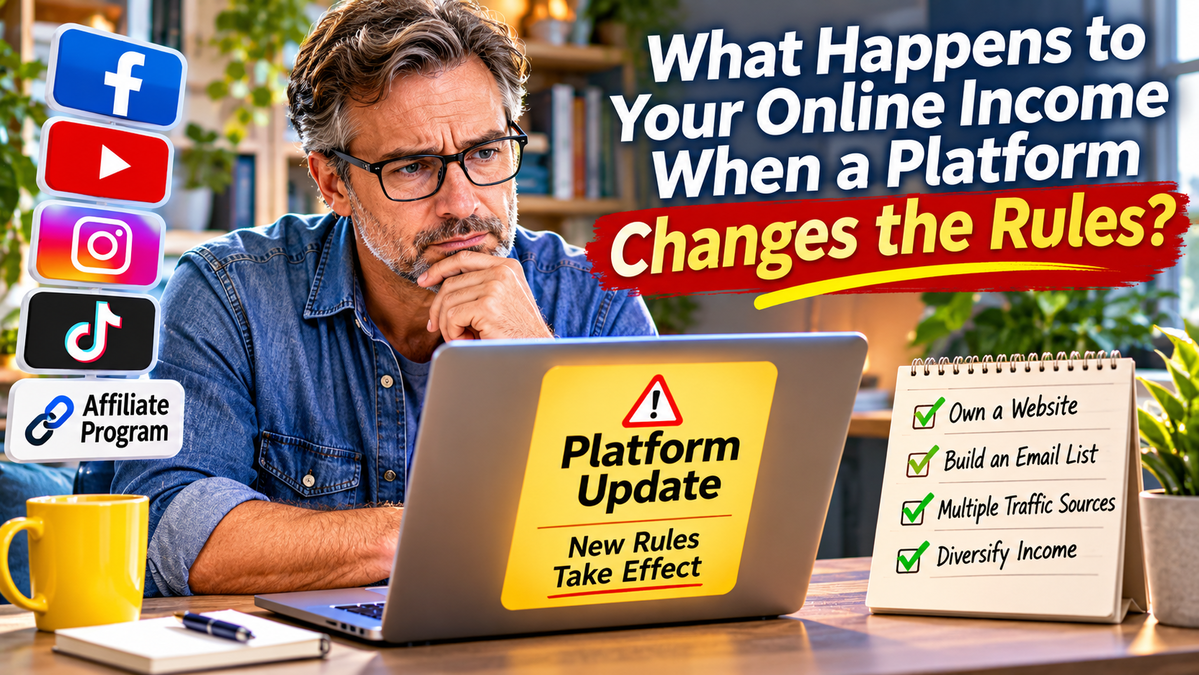
One week, your Facebook posts are reaching thousands of people. The next, they’re barely reaching your relatives. Your YouTube videos have been attracting steady traffic, but a recommendation algorithm changes and views suddenly drop. Or an affiliate program that has been paying you reliable commissions announces a new compensation structure.
You haven’t necessarily done anything wrong.
Someone else simply changed how the game works.
And if most of your income depends on that one game, the consequences can be painful.
The Hidden Risk of Building on Borrowed Ground
There’s nothing wrong with using social media, search engines, online marketplaces, or affiliate programs to build a business. They’re incredible tools.
The problem begins when we confuse having access to a platform with having control over it.
Consider someone who has spent three years building a successful Instagram account. They’ve published hundreds of posts, answered thousands of comments, and attracted 40,000 followers.
That’s a meaningful accomplishment.
But here’s an uncomfortable question: How many of those 40,000 people could they reach tomorrow if Instagram stopped showing their posts?
If they don’t have an email list, website, or another reliable way to communicate with those followers, the answer might be surprisingly few.
The audience exists, but the connection is controlled by somebody else.
The same principle applies to affiliate marketing.
You might be earning $2,000 a month promoting a particular product. Then the company reduces commissions, changes its tracking system, discontinues the product, or closes its affiliate program entirely.
Your traffic hasn’t disappeared. Your marketing skills haven’t vanished. But your income could take an immediate hit.
The biggest risk isn’t using someone else’s platform. It’s allowing that platform to become the only thing holding your business together.
When the Rules Change Overnight
Platform dependence isn’t a hypothetical problem. The internet has a long history of businesses being disrupted by decisions made outside their control.
Facebook’s organic reach has evolved dramatically over the years, forcing many businesses that once relied on free exposure to rethink how they attract customers.
Google regularly updates its search systems, sometimes significantly changing which websites receive traffic. A site that enjoyed excellent rankings for years can experience a sudden decline even while its owner continues publishing useful content.
YouTube adjusts how it recommends videos and enforces monetization policies. Creators may discover that a strategy that worked beautifully last year isn’t nearly as effective today.
And affiliate programs? They’re businesses too. They can adjust commissions, change eligibility requirements, alter payment terms, or shut down.
Sometimes these changes are reasonable. Platforms have to fight spam, improve user experiences, respond to regulations, and maintain profitable operations.
But whether a change is justified doesn’t make the financial consequences any easier for the small business owner affected by it.
Here’s the distinction worth remembering: A platform can be an excellent business partner without being a dependable business foundation.
Your Website Should Be More Than an Online Business Card
One of the smartest ways to reduce platform dependence is to create a central home for your business.
A website you control can become that home.
Not simply a page with your photograph and a few affiliate links, but a useful destination where people can learn from you, explore your recommendations, and find reasons to return.
Suppose you run a website about starting a home business.
You might publish practical articles about affiliate marketing, compare useful business tools, answer common beginner questions, and share lessons about attracting customers.
You could promote those articles through Facebook, Pinterest, YouTube, search engines, and other channels.
But instead of making those platforms the final destination, you use them to introduce people to your website.
That changes the relationship.
If Facebook traffic declines, your website still exists. If Google rankings fluctuate, visitors from other sources can still find you. If a particular affiliate offer disappears, you can update your recommendations without rebuilding your entire online presence.
Of course, a website isn’t magically immune to problems. Hosting companies have policies, domain registrations must be maintained, and technical issues happen.
But using your own domain, maintaining backups, and choosing hosting arrangements that allow you to move your site give you considerably more flexibility than relying exclusively on a social media profile.
Your website becomes the place where your business comes together, rather than another isolated account in somebody else’s ecosystem.
The Most Valuable Audience Is One You Can Reach Again
Imagine two entrepreneurs.
The first has 25,000 social media followers but no email list.
The second has 3,000 email subscribers who voluntarily signed up to receive useful information about a particular topic.
Who has the stronger business?
There’s no automatic winner. Engagement, trust, relevance, and purchasing behavior all matter.
But the second entrepreneur has an important advantage: a more direct way to communicate with people who have expressed interest in hearing from them.
That advantage becomes especially valuable when social media algorithms change.
Email marketing isn’t perfect. Messages can land in spam folders, subscribers can lose interest, and email service providers have their own rules.
Still, a permission-based email list that you can export and move between reputable providers offers a degree of portability that social media followers generally don’t.
And unlike a social media feed, where an algorithm decides whether someone sees your content, email gives you an opportunity to reach subscribers directly.
The goal isn’t to collect as many addresses as possible.
It’s to build a relationship with people who actually want to hear from you.
That means giving them a good reason to subscribe, respecting their inboxes, and consistently delivering something worthwhile.
A small, engaged list can be far more valuable than a huge collection of people who barely remember signing up.
Don’t Confuse Multiple Income Streams With Real Diversification
Here’s where things get interesting.
Someone might proudly announce that they have seven different affiliate income streams.
Sounds diversified, doesn’t it?
But suppose all seven are promoted through the same Facebook page.
If that page gets restricted or loses most of its reach, all seven income streams could suffer simultaneously.
That’s not quite the protection it appears to be.
Real diversification means looking at several different kinds of dependence.
Traffic diversification: Are visitors finding you through more than one source?
Income diversification: Are you earning from more than one product, company, or business model?
Audience diversification: Can people connect with you outside the platform where they first discovered you?
Operational independence: Can you access your content, customer records where appropriate, and important business data if a service becomes unavailable?
You don’t need dozens of platforms or an exhausting collection of affiliate programs.
In fact, trying to manage too many things at once can become its own problem.
A more practical approach is to build one dependable foundation, then gradually add complementary sources of traffic and revenue.
For example, an affiliate marketer might combine helpful website content, an email newsletter, a YouTube channel, and two or three carefully selected affiliate partnerships.
That’s manageable for many solo entrepreneurs, and it provides more flexibility than putting everything into one platform.
A Simple Exercise That Reveals Your Biggest Weakness
Here’s something worth doing before another platform update catches you by surprise.
Take a sheet of paper and write down the three biggest sources of traffic and income for your online business.
Then ask yourself:
- What would happen if my largest traffic source disappeared for 30 days?
- What percentage of my income depends on one affiliate program?
- Could I contact my regular audience without using my biggest social platform?
- Do I have current backups of my website, content, and important business information?
- If I had to replace my primary income source, what would I do first?
You don’t need precise financial forecasts to learn something useful from this exercise.
Even rough answers can reveal where your business is most vulnerable.
Maybe 80% of your visitors come from Google. Perhaps nearly all your commissions come from one affiliate company. Or maybe you’ve built a wonderful social following but have never invited those people to join your email newsletter.
These aren’t reasons to panic.
They’re opportunities to strengthen your business while things are still going well.
And that’s a much better time to make improvements than after an unexpected disruption.
Build Something That Gets Stronger With Time
One of the most appealing things about online business is the possibility of creating assets that continue providing value long after the initial work is finished.
A useful article can attract readers for years. A helpful email sequence can introduce new subscribers to your best ideas. A trustworthy recommendation can continue generating interest as new people discover your website.
But there’s an important difference between building an asset and building activity.
Posting three times a day on a platform might produce results, but if those posts disappear from people’s feeds within hours, you may find yourself constantly starting over.
Publishing useful material on your own website gives that work a more permanent home.
Building an email list allows relationships to continue beyond the original encounter.
Developing a recognizable voice and reputation makes people more likely to look for you, rather than simply consume whatever an algorithm puts in front of them.
None of this eliminates the need for ongoing work.
It simply means that more of your effort can contribute to something lasting.
You Don’t Have to Abandon the Platforms
There’s a temptation, after hearing about algorithm changes and affiliate program closures, to conclude that social media and third-party platforms should be avoided entirely.
That would be a mistake.
These platforms provide access to audiences that would be difficult and expensive for most independent entrepreneurs to reach on their own.
The smarter strategy is to use them intentionally.
Create videos on YouTube. Share useful ideas on Facebook. Publish content that search engines can discover. Participate in communities where your expertise is relevant.
But give interested people a natural next step.
Invite them to read a related article on your website. Offer a genuinely useful free resource through an email signup. Encourage them to bookmark your site or subscribe to your newsletter.
And make sure those invitations provide real value, rather than feeling like constant attempts to move people into a sales funnel.
Think of each platform as a road leading toward your business, not the business itself.
Some roads will be busy. Others will slow down. Occasionally, one may close.
The goal is to make sure there’s more than one way for people to find you.
The Real Meaning of Online Business Freedom
We often talk about online business freedom in terms of working from home, choosing our hours, or earning money without a traditional employer.
Those are attractive possibilities.
But there’s another kind of freedom that deserves just as much attention.
It’s the freedom to adapt.
To change affiliate partners when a better opportunity appears. To communicate with your audience when an algorithm stops cooperating. To move your website if your hosting arrangement no longer serves you. To explore a new marketing channel without risking everything you’ve already built.
You may never control the rules that Facebook, Google, YouTube, or an affiliate company decides to change.
And that’s okay.
You don’t have to control the entire internet to build a resilient online business.
You just need to make sure that no single corner of it controls your future.
Because the strongest online business isn’t necessarily the one getting the most traffic today. It’s the one that can still thrive when tomorrow’s rules are different.

Stone Evans is the founder of Plug-In Profit Site and a longtime online entrepreneur who has helped thousands of people build real income online. After leaving a traditional brick-and-mortar business, Stone built a multiple six-figure income online by focusing on simple systems, consistency, and helping others succeed. He now runs Plug-In Profit Site to make starting an online business faster, easier, and more accessible for everyday people. Learn more about how Stone helps beginners build income online through his step-by-step system.