
Imagine opening a little coffee shop on a busy street.
Every morning, you stand outside waving at passing cars, handing out flyers, and doing everything possible to convince people to walk through your door.
And it works! People come in. Some even buy a coffee.
But tomorrow morning, you’re right back outside waving at traffic again.
Meanwhile, the coffee shop down the street has a line of regulars. Nobody’s handing out flyers. Nobody’s begging for attention. People simply know where they want to go.
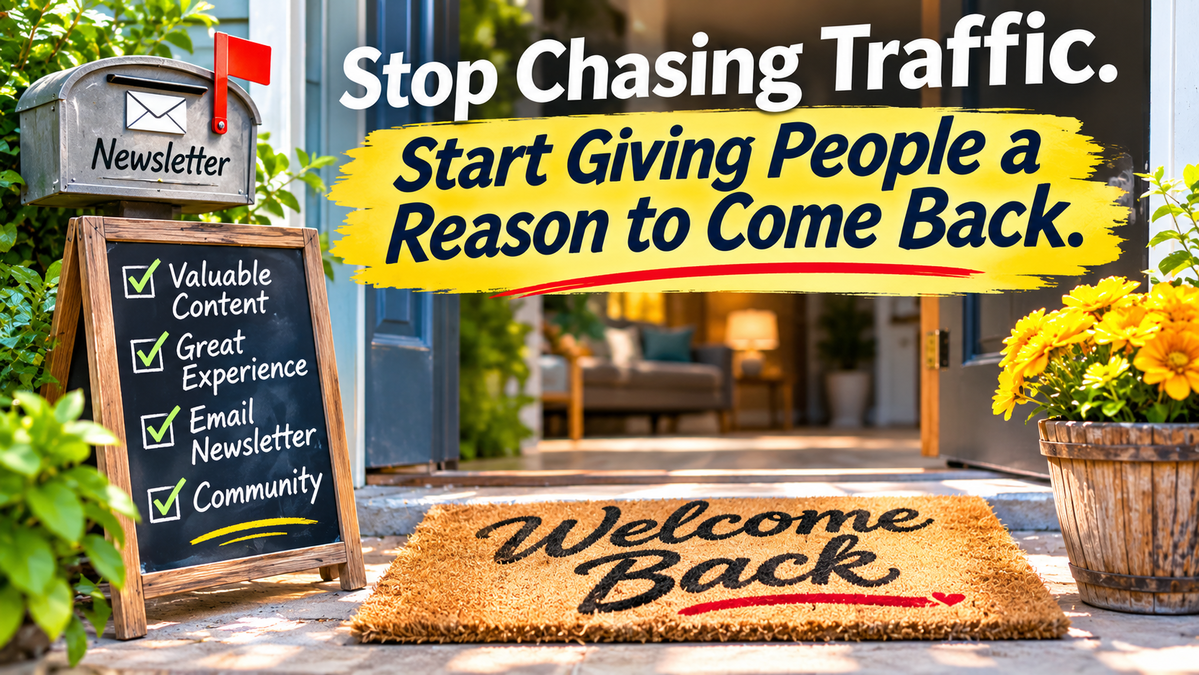
What’s the difference?
The second coffee shop gave people a reason to return.
And that simple distinction might be one of the most overlooked lessons in building an online business.
The Traffic Treadmill Nobody Talks About
If you’ve spent much time learning about online marketing, you’ve probably heard some version of the same advice a thousand times.
Get more traffic. Post more content. Share more links. Find new audiences. Promote, promote, promote.
There’s nothing inherently wrong with that advice. Every business needs new people discovering it.
But there’s a problem when attracting new visitors becomes your entire strategy.
You start every day at zero.
Yesterday’s social media post disappears into the feed. Last week’s promotional link is forgotten. The visitors you worked so hard to attract may never remember your website existed.
So you post again. And again.
Eventually, running your business starts to feel suspiciously like feeding a machine that’s never full.
The solution isn’t necessarily to work harder at getting traffic.
It’s to make the traffic you’ve already earned more valuable.
One Hundred Visitors Who Remember You
Consider two hypothetical websites.
Website A attracts 10,000 visitors a month. Most arrive through promotional posts, glance around for a few seconds, and leave. Almost nobody remembers the website’s name.
Website B attracts just 1,000 visitors a month. But its readers find the content genuinely useful. Some subscribe to the newsletter. Others bookmark articles. A few return every week to see what’s new.
Which website would you rather own?
There’s no automatic winner. Traffic quality, revenue, and business models matter. But Website B has something Website A may be missing.
An audience that’s beginning to form a relationship with the business.
Those returning visitors are no longer complete strangers.
They recognize the website. They understand what it offers. They may even look forward to hearing from it.
And when the time comes to recommend a product, introduce a service, or ask for a sale, that familiarity can make a meaningful difference.
Traffic brings people to your door. Trust gives them a reason to stay connected.
Give People Something They’d Actually Miss
Here’s a surprisingly useful question to ask about your website:
If I stopped publishing tomorrow, would anyone notice?
It’s not a comfortable question. But it’s revealing.
A website filled with generic articles, recycled advice, and promotional links might technically provide information. Yet it may offer very little that readers can’t find in a hundred other places.
Memorable content works differently.
It might explain a confusing subject in unusually simple language. It might challenge a popular assumption. It might offer a practical solution to a problem people struggle with every day.
Sometimes it’s the personality behind the writing that makes the difference.
Think about the websites, newsletters, or creators you voluntarily revisit.
Chances are, you don’t return because they publish the most frequently or use the cleverest headlines.
You return because you consistently get something worthwhile.
Maybe you learn something. Maybe you’re entertained. Maybe you feel understood.
The important thing is that you leave with more than you arrived with.
For an affiliate marketer, that could mean publishing an honest comparison that helps readers avoid purchasing the wrong tool.
For someone building a home business website, it might mean sharing a detailed beginner’s guide that answers the questions other websites conveniently skip.
For a small business owner, it could be a collection of practical tips that helps customers succeed long after their first purchase.
The goal isn’t to produce more content than everyone else.
It’s to produce content people are glad they found.
Your Email Newsletter Is an Invitation, Not a Megaphone
Email marketing is often presented as another promotional channel.
Build a list. Send offers. Make sales.
And yes, email can be effective for promoting products and services.
But treating every subscriber as another person to advertise to misses much of its potential.
An email newsletter can become something people actually enjoy receiving.
Imagine a short weekly message that includes an interesting observation, one useful tip, and a link to something worth reading.
No dramatic income promises. No manufactured urgency. No endless parade of special offers.
Just a genuinely helpful message from someone who seems to understand the reader’s interests.
Over time, those messages can establish a sense of familiarity that a random social media post rarely achieves.
Your readers start recognizing your name.
They know what to expect.
And ideally, opening your email becomes a pleasant habit rather than another interruption.
That doesn’t mean you should never promote anything.
It means your promotions should exist within a relationship built on usefulness.
A practical way to begin is to give your newsletter a recognizable purpose.
Instead of vaguely promising “updates and special offers,” offer something specific:
A weekly online business idea. A Friday marketing lesson. One useful tool explained every Tuesday.
Give subscribers a clear reason to sign up, and then consistently deliver on that promise.
You don’t need to email people every day. You need to make the emails you send worth opening.
Make Your Website Feel Like a Destination
There’s a difference between a website people visit accidentally and a website people visit intentionally.
The first depends heavily on search engines, social platforms, advertisements, and outside referrals.
The second begins developing its own identity.
Think about a favorite recipe website, a useful hobby forum, or a publication you enjoy reading.
You might discover it through Google or social media initially. But eventually, you stop needing those platforms to remind you it exists.
You simply go there.
That shift is enormously valuable.
And it doesn’t require a massive website or a sophisticated technical setup.
You can start by creating recurring features that give readers something to anticipate.
Perhaps every Monday you publish a practical marketing idea.
Maybe once a month you review a useful online business tool.
You could create an ongoing series documenting common mistakes beginners make and how to avoid them.
The specific format matters less than the consistency and value.
You’re creating a small appointment in someone’s mind.
Something they can remember and return for.
Of course, the experience matters too.
A website overloaded with intrusive popups, confusing navigation, and aggressive advertising isn’t exactly inviting people to settle in.
Make it easy to read. Make useful content easy to find. Link related articles together. Help visitors discover something else interesting before they leave.
Sometimes improving the experience you already offer is more productive than chasing another thousand visitors.
Community Makes People Part of the Experience
One of the most powerful reasons people return to a website or business has surprisingly little to do with the content itself.
It’s the other people.
Consider a small online community where members ask questions, exchange ideas, and help each other solve problems.
A visitor might originally join because of a helpful article.
But they return because they enjoy the conversations, recognize familiar names, or feel connected to people working toward similar goals.
The website has become more than a source of information.
It’s become a place where they belong.
You don’t need to launch an elaborate membership platform to encourage that feeling.
Start small.
Invite readers to reply to your newsletters. Ask thoughtful questions at the end of articles. Respond when people leave genuine comments. Encourage readers to share their own experiences.
And when someone takes the time to contact you, treat that interaction as more than another item to clear from your inbox.
People remember being heard.
There’s also something refreshing about an online business owner who seems interested in having a conversation rather than immediately steering every interaction toward a purchase.
That kind of approach might not generate an impressive-looking traffic spike.
But it can help create the relationships that keep a business alive.
The Problem With Measuring Only New Visitors
Open almost any website analytics dashboard, and you’ll find numbers that can become strangely addictive.
Pageviews. Sessions. Clicks. Impressions.
It’s easy to spend hours watching those numbers rise and fall.
But here’s an interesting thought.
What if the most important thing happening on your website isn’t how many new people arrive?
What if it’s how many people decide you’re worth visiting again?
Instead of focusing exclusively on traffic volume, start paying attention to signals of genuine interest.
Are people returning to your website? Are they subscribing to your newsletter? Are subscribers clicking through to read your articles? Are readers replying, asking questions, or sharing your content with others?
These aren’t perfect measurements. Returning-visitor reports can be affected by privacy settings and tracking limitations, and email open rates aren’t always reliable.
Still, looking at several engagement signals together can reveal something raw traffic numbers miss.
Whether your audience is becoming more connected to what you’re building.
A smaller audience that genuinely cares about your work can be a better foundation for a sustainable business than a much larger audience that barely remembers you.
Try the Return-Visit Challenge
Here’s a simple experiment you can run over the next 30 days.
Don’t stop promoting your website entirely. New visitors still matter.
Instead, redirect some of the time you normally spend chasing attention toward improving what happens after someone arrives.
Choose one genuinely useful article on your website and make it substantially better. Add examples, answer unanswered questions, and remove anything that feels like filler.
Create a reason for visitors to subscribe to your email list that goes beyond receiving advertisements.
Start one recurring content feature that people can look forward to.
And find a way to invite conversation, whether through comments, email replies, or a small community.
Then pay attention to what happens.
Do more visitors explore multiple pages? Are more people subscribing? Are readers coming back? Are you beginning to receive responses from people who recognize your work?
You might not see dramatic results in 30 days.
Relationships rarely develop on a convenient marketing schedule.
But you’ll be working on something that can become increasingly valuable over time instead of disappearing the moment you stop posting.
Build Something Worth Returning To
There’s an irony in online marketing.
We have more tools than ever for reaching strangers, yet many businesses struggle to create lasting connections with the people they’ve already reached.
We can schedule promotional posts for months, automate entire marketing campaigns, and publish content faster than ever before.
But none of those capabilities automatically gives someone a reason to care.
That’s still earned through usefulness, consistency, personality, and trust.
The most successful approach isn’t to abandon traffic generation. It’s to stop treating every visit as an isolated event.
Think of each new visitor as someone you’re welcoming into a place you’re building.
Give them a good experience. Help them accomplish something. Make it easy to stay connected.
And give them a reason to wonder what you’ll share next.
Because the real opportunity isn’t simply getting someone to click your link today.
It’s becoming a website they remember tomorrow, even when nobody reminds them to visit.

Stone Evans is the founder of Plug-In Profit Site and a longtime online entrepreneur who has helped thousands of people build real income online. After leaving a traditional brick-and-mortar business, Stone built a multiple six-figure income online by focusing on simple systems, consistency, and helping others succeed. He now runs Plug-In Profit Site to make starting an online business faster, easier, and more accessible for everyday people. Learn more about how Stone helps beginners build income online through his step-by-step system.