
The internet has become very good at getting our attention.
A shocking headline. A dramatic thumbnail. A countdown timer warning that an offer disappears in 17 minutes. Someone promising to reveal the secret that everyone else has apparently been hiding from us.
Click.
And just like that, another little victory for the attention economy.
But here’s something worth thinking about: The things that make someone click aren’t necessarily the things that make someone trust you.
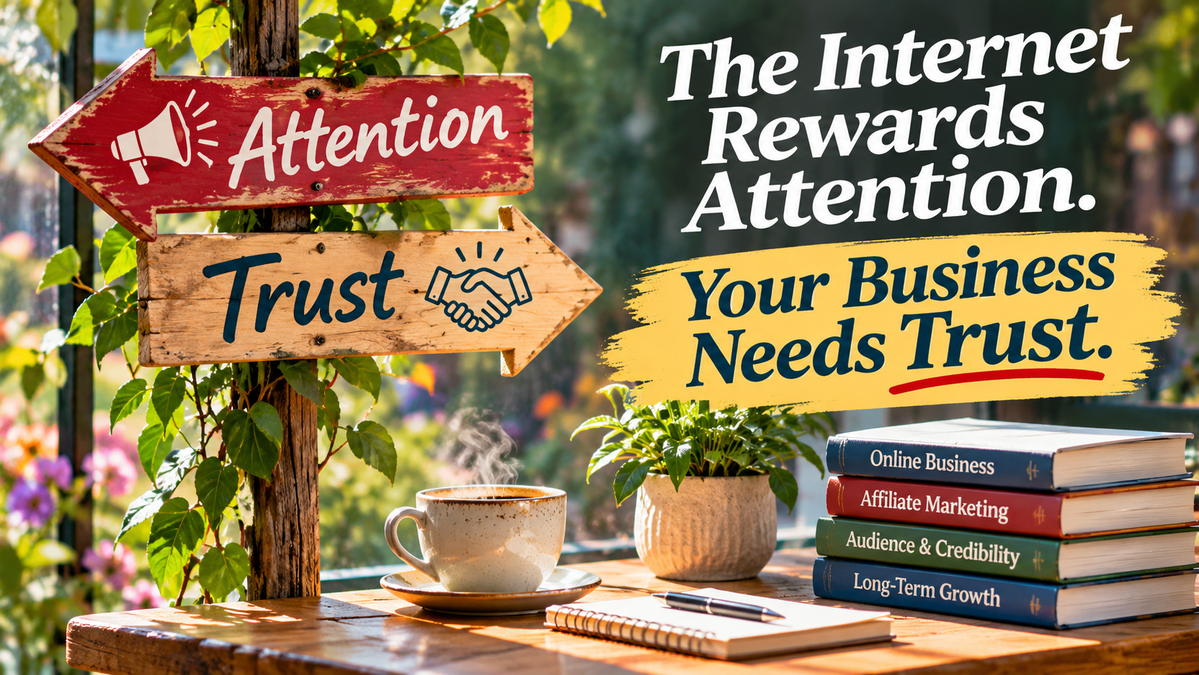
In fact, sometimes they’re the exact opposite.
That’s an important distinction if you’re building an online business, especially one that depends on people believing your recommendations, joining your email list, or eventually purchasing something through you.
Because while attention might bring someone to your website, trust is what gives them a reason to stay.
And more importantly, a reason to come back.
We’ve Become Experts at Getting Noticed
There’s an entire industry devoted to figuring out what makes people stop scrolling.
Marketers study headlines, colors, emotional triggers, curiosity gaps, and the psychology behind clicking a button.
None of that is inherently bad.
A compelling headline helps good information get discovered. An interesting image can introduce someone to an article that genuinely improves their life. A well-written advertisement can connect a person with exactly the solution they’ve been searching for.
Attention is necessary. Without it, even the most valuable business in the world can remain invisible.
The problem begins when getting attention becomes more important than deserving it.
Think about how often you’ve clicked an article promising something extraordinary, only to discover that the actual content barely resembles the headline.
Or watched a video that spent eight minutes building anticipation for information that could have been explained in thirty seconds.
Or visited a website where every paragraph seemed designed to push you toward another button.
You might have given those businesses your attention.
But did you give them your confidence?
Probably not.
And that’s where the economics of attention and the economics of trust begin moving in different directions.
A Click Is a Moment. Trust Is a Relationship.
Imagine two people recommending the same online business tool.
The first person tells you it’s absolutely incredible. Everyone should be using it. It’s the best thing they’ve ever discovered, and you’d be foolish to miss out.
The second person explains what the tool does, who it’s particularly useful for, where it falls short, and why they believe it’s worth considering.
They might even tell you that a less expensive alternative would be perfectly adequate if you’re just getting started.
Which recommendation would you take more seriously?
The second person might not sound quite as exciting.
But they’re demonstrating something far more valuable than enthusiasm.
They’re showing you that your interests matter more than their immediate opportunity to earn a commission.
That changes the entire nature of the interaction.
Instead of feeling like someone is trying to sell you something, you feel like someone is helping you make a good decision.
And when you encounter another problem a few months later, whose website are you more likely to remember?
The person who made the biggest promises?
Or the person who helped you understand your options?
That’s how trust quietly compounds.
The Most Powerful Recommendation Might Be the One You Don’t Make
Here’s a situation worth considering.
Suppose you run a website about starting an online business, and someone asks whether they should purchase an expensive marketing platform.
You’re an affiliate for that platform. If they sign up through your link, you earn a commission.
But after learning a little about their situation, you realize they’re still trying to figure out what kind of business they want to build.
They don’t have a website. They haven’t chosen a niche. They aren’t even sure who their customers might be.
Do they really need a sophisticated marketing platform right now?
Probably not.
A trustworthy recommendation might sound something like this:
“That’s a good platform, but I wouldn’t spend money on it just yet. Get your basic business foundation in place first. Once you know what you’re promoting and who you’re trying to reach, you’ll be in a much better position to decide whether you need it.”
You might lose a commission today.
But you’ve also done something that no advertising campaign can manufacture.
You’ve demonstrated judgment.
And perhaps more importantly, you’ve demonstrated that your advice isn’t automatically determined by what pays you.
That kind of credibility can become one of the most valuable assets in an affiliate marketing business.
Not because every person you help will eventually purchase something.
But because people are far more comfortable doing business with someone whose recommendations they believe they can trust.
What Trust Actually Looks Like Online
Trust can sound like an abstract concept until you examine the small decisions that create it.
It’s rarely one grand gesture.
More often, it’s a collection of ordinary experiences that leave people thinking, “This person seems to know what they’re talking about, and I don’t feel like they’re trying to fool me.”
Consider how differently two websites might approach the same subject.
The same marketing opportunity. Two very different priorities.
Neither approach requires an enormous marketing budget.
The difference is in what each business is optimizing for.
One is primarily trying to extract an immediate action.
The other is trying to create an experience worth repeating.
Of course, trustworthy businesses still need persuasive headlines, effective calls to action, and products that generate revenue.
Being credible doesn’t mean being timid about marketing.
It means making sure the substance behind your marketing lives up to the expectations you create.
Your Email List Is Where the Difference Becomes Obvious
Nowhere is the difference between attention and trust more apparent than in email marketing.
Getting someone to subscribe is an accomplishment.
Getting them to look forward to your emails is something else entirely.
Imagine subscribing to two newsletters about online business.
The first sends you a promotional email every morning.
Today’s incredible opportunity. Tomorrow’s can’t-miss system. Friday’s secret method for generating income while you sleep.
Every message sounds urgent. Every product sounds revolutionary.
After a while, you begin to recognize the pattern.
The second newsletter takes a different approach.
One day, it explains a useful marketing concept. Another day, it shares an interesting business idea. Occasionally, it recommends a product, but with a clear explanation of why someone might find it useful.
Sometimes it simply helps you avoid a common mistake.
Which email are you more likely to open six months from now?
That’s why a subscriber count alone tells you surprisingly little about the health of an email-based business.
A list of 10,000 people who rarely read your messages isn’t automatically more valuable than a list of 1,000 people who genuinely appreciate hearing from you.
The numbers matter, certainly.
But the relationship behind those numbers matters too.
And there’s a practical lesson here for anyone building an autoresponder campaign: Every email is an opportunity either to strengthen the relationship or slowly wear it down.
You don’t need to eliminate promotional messages.
You need to make sure your subscribers have good reasons to welcome the next one.
Five Small Ways to Become More Trustworthy
The encouraging thing about building credibility is that you don’t need to be famous, have a massive audience, or present yourself as an expert on everything.
In fact, pretending to know everything is often a pretty effective way to undermine trust.
Here are five practical habits that can make a meaningful difference.
1. Be Specific Instead of Spectacular
“This tool will transform your business” sounds exciting.
“This tool can automatically send follow-up emails to people who subscribe through your website” actually tells someone something useful.
Specific explanations help people understand what they’re getting.
And understanding makes decisions easier.
2. Acknowledge Limitations
Every product has limitations. Every strategy involves tradeoffs.
A website builder might be inexpensive but offer limited customization. A marketing service might save time but require a learning curve. A business opportunity might have potential but demand consistent effort before producing results.
Acknowledging those realities doesn’t weaken your recommendation.
It makes the recommendation more believable.
3. Explain Who Something Is For
Not every solution is appropriate for every person.
A beginner with a limited budget has different needs from an experienced entrepreneur managing several websites.
When you explain who benefits most from a product or strategy, you help readers recognize whether it fits their situation.
That’s more useful than insisting everyone needs the same thing.
4. Deliver What Your Headline Promises
If your headline offers seven practical ways to improve a website, give readers seven genuinely useful ideas.
If you promise a beginner’s guide, make sure a beginner can understand it.
And if you offer free training in exchange for an email address, make the training easy to access.
It sounds obvious, but consistently meeting expectations is one of the simplest ways to build credibility.
5. Be Willing to Say “I Don’t Know”
There’s nothing wrong with having an opinion.
There’s also nothing wrong with recognizing the limits of your knowledge.
You can recommend a tool based on its documented features without pretending you’ve personally tested every aspect of it.
You can share a useful idea without claiming it’s guaranteed to work.
Being transparent about what you know, what you’ve researched, and what remains uncertain is a strength, not a weakness.
Trust Doesn’t Mean Giving Everything Away
There’s an interesting misconception that sometimes appears in discussions about ethical marketing.
The idea is that if you’re genuinely trying to help people, you shouldn’t be concerned about making money.
That’s nonsense.
A business needs revenue. Affiliate marketers deserve compensation for valuable referrals. Content creators need ways to support the work they produce.
There’s nothing contradictory about helping people and earning an income.
The important question is whether the value you’re creating justifies the trust people place in you.
A useful product recommendation can benefit everyone involved.
The customer discovers something that solves a problem. The company gains a customer. The affiliate earns a commission for making the connection.
That’s a perfectly reasonable exchange.
Problems arise when the commission becomes more important than whether the product is appropriate for the person purchasing it.
The strongest long-term businesses understand that these interests don’t have to compete.
Helping people make better decisions can be part of what makes a business profitable.
The Advantage That Gets Stronger With Time
There’s another reason trust deserves more attention from online entrepreneurs.
Attention is increasingly easy to purchase, compete for, and imitate.
Someone can create a similar advertisement. Copy a headline structure. Use the same trending topics. Produce dozens of articles about the same subject.
But a genuine relationship with an audience is harder to duplicate.
If readers have repeatedly found your information useful, they bring that experience with them the next time they encounter your work.
They don’t have to evaluate you from scratch.
They already have some idea of what to expect.
That doesn’t make trust permanent. It can disappear remarkably quickly when a business stops behaving consistently with the expectations it has created.
But when credibility is earned and maintained, it can reduce the need to constantly convince people that you’re worth listening to.
And that’s a meaningful advantage for a small online business competing in a very crowded marketplace.
The Question Worth Asking Before You Publish
The next time you’re writing an article, creating an advertisement, sending an email, or recommending an affiliate product, try asking yourself one simple question:
“Will someone trust me more after experiencing this?”
Not just whether they’ll click.
Not just whether they’ll subscribe.
Not even whether they’ll purchase.
Will they come away feeling that their time was respected, their questions were answered, and the information they received was worth their attention?
You won’t always get it perfectly right. Nobody does.
But consistently asking that question can change how you approach almost every part of your business.
Because the internet will continue rewarding attention. There will always be another sensational headline, another clever advertising trick, and another promise competing for the next click.
You don’t have to win every one of those battles.
You just have to become someone people are glad they discovered.
Attention gets you noticed. Trust makes you worth remembering.
And if you had to build an entire business around just one of those things, which would you rather have?

Stone Evans is the founder of Plug-In Profit Site and a longtime online entrepreneur who has helped thousands of people build real income online. After leaving a traditional brick-and-mortar business, Stone built a multiple six-figure income online by focusing on simple systems, consistency, and helping others succeed. He now runs Plug-In Profit Site to make starting an online business faster, easier, and more accessible for everyday people. Learn more about how Stone helps beginners build income online through his step-by-step system.